


Accelerating decarbonization in the hospital sector: challenges and prospects

  • Article
  • Health
  • Published December 5, 2023

By Caroline SCHWARTZ, Manager

The findings of the latest report IPCC is unequivocal: global warming is underway - +1.1°C since the end of the 20th century.ème century - and this trend will continue if greenhouse gas emissions are not sharply and rapidly reduced. The national low-carbon strategy has set France a target of carbon neutrality by 2050, with an interim goal of reducing GHG emissions by 40% by 2030 compared to 1990 levels. The hospital sector holds a paradoxical position: it emits 8% of GHGs in France, equivalent to 49 million tonnes of CO2, It is as much a contributor to the climate crisis as it is a victim of its effects, being on the front line when it comes to dealing with the impact on people's physical and mental health.

Between necessity and opportunity, healthcare establishments and their supervisory bodies have a key role to play in decarbonizing the sector.


The hospital sector contributes to the climate crisis and suffers its effects


The healthcare sector accounts for 8% of greenhouse gas emissions in France

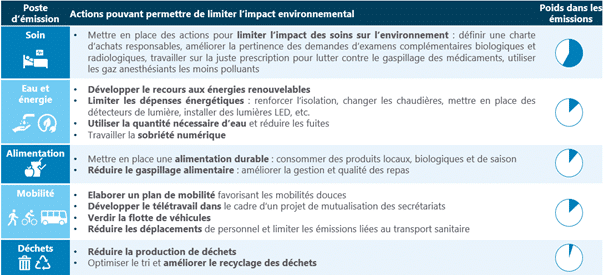
The healthcare sector is a major contributor to GHG emissions. Three main areas of emissions have been identified


  • The consumption of medicines and medical devices accounts for half of the sector's emissions.
  • Energy consumption accounts for 12% of sector emissions
  • Mobility of healthcare professionals and patients, accounting for 13% of the sector's emissions


While they contribute 37% to the sector's carbon footprint[1], Health establishments are already, and will continue to be, on the front line of the consequences of global warming. Among them, the spread of disease, heatwaves, droughts and cyclones are directly responsible for at least 150,000 deaths a year, a figure expected to double by 2030 according to the WHO. As a result, healthcare establishments will have to cope with a sharp increase in needs, against a backdrop of saturated resources.


[1] Shift Project data. Excluding emissions associated with the purchase of medicines and medical devices.

Despite late awareness, the decarbonization momentum is gathering pace


A sector with little experience of decarbonization issues

Long overlooked by decarbonization policies, the hospital sector is lagging behind in the definition and application of a regulatory framework.


  • Despite the legal obligation for public establishments hosting more than 250 people to carry out a carbon audit every 3 years, only 40% in public health establishments have one.
  • The Elan law imposes a reduction in energy consumption of 40% by 2030 for establishments of 1,000m². Implementation of the law is slowed down by its complexity, since it involves breaking down surface areas according to the Ministry's segmentation, and allocating energy consumption to each building using common meters, while excluding hot water consumption, which is not considered a priority at this stage.
  • If the Egalim law hospital catering to include 50% of quality products, including 20% from organic farming, from January 1, 2022, a survey carried out by Agence de l'environnement et de la maîtrise de l'énergie (Environment and energy management agency) (ADEME), shows that none of the respondent plants meet these targets.


The low financial penalties for non-compliance with regulations and the limited number of controls, compared with the investment costs required to implement ecological transition actions and the severe budgetary constraints weighing on establishments, tip the cost-benefit balance negatively. As a result, projects with an ecological dimension are almost systematically relegated to the back burner.

Ambulance cars in a row on a parking lot of hospital. 3d illustration

Gradual awareness on the part of all stakeholders


However, the Ministry of Health and Prevention, along with all the other players in the health sector, are gradually becoming aware of the climatic challenges and are beginning to take up the issue.

  • At national level, the steering committee for ecological planning in the healthcare and medico-social sector, was set up on May 22, 2023. Chaired by the Minister for Territorial Organization and the Health Professions, it brings together several ministries and key players in the healthcare sector, and is tasked with defining commitments to ensure the sector's long-term ecological transformation. The Ministry of Health and Prevention has also allocated, within the framework of the Ségur de la santé, a budget of 10 million euros per year to create and finance 151 positions for energy and ecological transition advisors in the healthcare sector (CTEES). Their mission is to help establishments reduce their carbon footprint.
  • The role of the Regional Health Agencies (ARS) in decarbonizing the sector has yet to be clarified, but some are specifying the actions they wish to take in their Schéma Régional de Santé. ARS Grand Est for example, is committed to: coordinating players around work linked to the energy and ecological transition, improving the knowledge and skills of stakeholders, and supporting the actions of the healthcare system, notably through the allocation of part of the Ségur de la santé funds.
  • Local hospital groups and health establishments are also taking initiatives at their own level. For example, they are integrating decarbonization into their strategic plans, setting up ad hoc committees, developing and promoting initiatives in the areas of healthcare, energy and mobility, and encouraging the sharing of best practices.


In addition, the’National Performance Support Agency has developed practical tools, field support and communities of practice for decision-makers and facility professionals. At the same time, the Assurance Maladie has set up the Mission nationale pour la Transition écologique du système de santé et la santé environnementale (National Mission for the Ecological Transition of the Healthcare System and Environmental Health) to work with healthcare players to decarbonize the sector.

Net benefits of decarbonization actions


Healthcare establishments are wondering about the return on investment of decarbonization actions, and have yet to be convinced. Often perceived as financially unattractive investments, decarbonization initiatives offer a number of advantages:

  • In the face of financial difficulties, sustainable transition can be a way of finding new sources of funding. As of 2024, specific funds will be allocated to the ecological renovation of public buildings in the medical sphere, as part of initiatives led by the General Secretariat for Ecological Planning. Other sources of funding are already available, but are little used because they are not well known to healthcare establishments: funding from the Agence de l'Eau, the Banque des Territoires, European funding, etc.
  • With electricity consumption equivalent to that of 5 million households, healthcare establishments are bearing the brunt of rising energy costs, and have seen their bills multiply by 3 to 4 in one year since 2022. Energy transition is crucial to controlling the operating costs associated with their activities. Changing the energy mix, renovating to avoid heat loss, adopting greener energies, etc. would enable facilities to both reduce their carbon footprint and stabilize their expenses over the long term.
  • Against a backdrop of declining attractiveness, and at a time when healthcare staff are showing a willingness to take action to decarbonize their activity, the ecological transition can help rally teams around a common, sustainable project that is likely to attract more healthcare professionals.


How do you go about decarbonizing your healthcare facility?

Action plans vary according to your level of progress.


Would your company like to embark on a decarbonization initiative?


Three stages separate you from the implementation of your first decarbonization actions:


1. Raise awareness of climate issues and acculturate teams to initiate changes in practices

The challenges of decarbonization remain little known within healthcare establishments. To change practices, you need to start by raising awareness among your teams. Various actions can be implemented:

  • Make management teams aware of short-, medium- and long-term impacts,
  • Acculturate on a larger scale using tools such as the Climate fresco, and by organizing internal working groups to share internal knowledge,
  • Share individual initiatives and encourage collective reflection.


2. Carry out a carbon assessment and define a shared action plan

It is essential to take stock of the situation in order to identify the main CO2 at your facility. Based on this diagnosis, you can define your decarbonization strategy and targets, and then identify and prioritize the projects you need to implement to achieve them. By co-constructing this stage with the teams in charge of implementing the projects, you will strengthen their support and the deployment of actions. Defining an operational roadmap will then enable you to get down to business.


3. Implement the decarbonization plan

The key to effective implementation of the roadmap lies in the establishment of an appropriate steering and governance structure. To achieve this, we,

  • Integrate the governance of decarbonation projects into existing bodies as far as possible, to avoid bogging down your teams,
  • Limit the number of indicators to be tracked to focus efforts on implementation rather than reporting
  • And structure a change management approach to encourage and support teams in these new practices.

Last but not least, don't forget to communicate on the results achieved, as this will encourage project leaders and help mobilize new teams.


Have you carried out your carbon assessment, initiated the first actions and would like to go further?


The next step is not the easiest, but it can bring you significant benefits, by improving patient satisfaction, your teams' practices and your financial situation.

This stage, is eco-design, This means protecting the environment right from the design stage of goods or services, by reducing their environmental impact throughout their life cycle.

Choose a department, the operating room for example, and detail the life cycle of the operations carried out there, i.e. the physical flows of materials and energy associated with these operations: extraction of the raw materials needed to produce the tools used, transformation, transport, distribution, use and disposal.

Then, for each stage, identify how you can reduce resource consumption, increase the useful life of remaining resources, and recover materials at the end of their life cycle by promoting repair, reuse and recycling.


Whatever your level of progress, you can mitigate the economic impact of decarbonization measures by activating dedicated financing.

More and more French and European funding is being created. Applications can be made for specific positions or for projects focused on decarbonization, such as the funding of CTEES or initiatives dedicated to the ecological renovation of public buildings, scheduled from 2024 onwards. They can also be applied to projects integrating actions aimed at reducing greenhouse gas emissions, such as Ségur de la santé funding, dedicated to day-to-day investments or renovation work in establishments. Setting up a funding watch, similar to the one set up by many establishments for calls for research projects, is a good way of identifying these sources of funding at low cost.


Faced with major difficulties, both financial and related to human resources, healthcare players have long relegated the decarbonization of their sector to the back burner. While the implementation of actions in this area will not solve all their problems, they can provide elements of a solution, while contributing to the achievement of the national low-carbon strategy.


Why aren't healthcare facilities doing more to decarbonize?

Our health sector


Eurogroup Consulting supports all healthcare players and social protection, central or within networks, in defining and implementing the changes needed to cope with changes in their ecosystem.

An article by
Other content that might interest you

Do you have a project? Have a question?

Our teams are ready to listen to your needs and work with you to develop tailor-made solutions.
Privacy Overview
Eurogroup Consulting

This website uses cookies so that we can provide you with the best user experience possible. Cookie information is stored in your browser and performs functions such as recognising you when you return to our website and helping our team to understand which sections of the website you find most interesting and useful.

Strictly Necessary Cookies

Strictly Necessary Cookie should be enabled at all times so that we can save your preferences for cookie settings.