



On June 12, 2023, Stanislas Guérini presented a package of measures to boost the purchasing power of all civil servants, making the attractiveness of the civil service one of the major projects of the Minister for Public Transformation and the Civil Service.
These measures are designed to respond to the concerns of civil servants, in a context of high inflation, but also to the difficulties of recruiting and attracting certain professions and profiles.
If remuneration alone is not enough of a lever to solve the problems associated with attractivenessIt is nonetheless a structuring element. However, in the civil service, the rules governing employee remuneration are mainly based on statutory principles that leave administrations little room for manoeuvre.
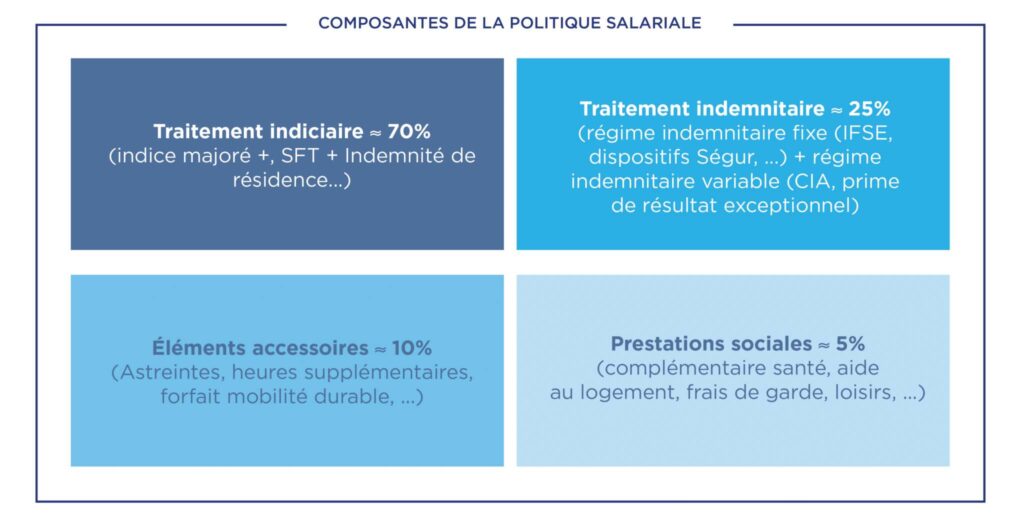
Today, it is ultimately on the compensation component - which represents on average between 15 and 30% of staff remuneration - that public employers can consider concentrating their efforts to gain flexibility and better respond to their HR strategy and ambitions.
For public-sector HR departments, the challenge is to use the IR tool as part of an overall, coherent and assertive pay policy - integrating all the other components of this policy - to boost the attractiveness and loyalty of their staff.
1. KEY DRIVERS OF ATTRACTIVENESS
Thinking about attractiveness means simultaneously examining several dimensions at the heart of the employee experience. The levers of attractiveness in the civil service can be summarized as follows:
Remuneration is both a component of and a lever for enhancing attractiveness, and should be taken into account as part of an overall approach to attractiveness. Nevertheless, and particularly in the public sector, the subject of remuneration as such can seem a priori even though it is the subject of strong demands in the current period.
So.., attractiveness cannot be summed up by remuneration alone, without taking into account all the elements that contribute to the agent's experience: quality of the living and working environment, the dynamism of the position and the projects to be carried out, the values conveyed and supported by the employer, working and management conditions, career and skills development prospects, etc. It's the combination of these factors, along with remuneration, that defines a satisfactory agent experience.
2. REMUNERATION: AN IMPORTANT - BUT NOT EXCLUSIVE - FACTOR IN ATTRACTING AND RETAINING STAFF
Against a backdrop of high inflation, the question of salaries and purchasing power is particularly acute. The survey carried out in October 2022 by IFOP for the Observatoire des Politiques Publiques reveals that the issue of remuneration is an obstacle to career prospects in the civil service, particularly among young people.
Similarly, the salary outlook conference de la fonction publique published in March 20222 highlights that a significant proportion (over 40%) of civil servants consider themselves poorly paid, with disparities linked to status and professions. This tension around the question of remuneration is further exacerbated by working conditions deemed to be deteriorating, whether in terms of increasing workloads, work organization, working environment (management, relations with constituents, real estate, etc.) or equipment.
Today, the challenge around attractiveness is to be able to take into account and combine remuneration with the many factors that contribute to a satisfactory agent experience:
- The nature of the job and duties performed
- Tension over skills
- Career level
- The arduous nature of the work
- The level of recognition

Nevertheless, in the civil service, the idea of modulating/adapting remuneration to profile or profession is met with reluctance. It is likely to run counter to the principle of equal treatment for all staff in the same corps/grade, by introducing new parameters for differentiation based on less administrative logic.
3. REMUNERATION PRINCIPLES IN THE CIVIL SERVICE
A MAIN REMUNERATION PACKAGE WITH TIGHTLY CONTROLLED CAREER PATHS
A civil servant's remuneration, known as salary, is made up of an indexed component - based on a corps / grade / step logic - and an indemnity component based mainly on the duties and responsibilities performed³. The main part of a civil servant's salary is based on his or her grade and step, which determines his or her gross index, which in turn is linked to an increased gross index set by Decree. The minimum pay index is indexed to the SMIC, which has led to a reduction in pay scales against a backdrop of index point freezes. For example, a category C employee will have to wait an average of 12 years for his or her increased index to exceed the level of the SMIC.
Although this system is particularly tightly controlled, there are a number of levers that can be used to boost compensation. These include :
- index point increase (centralized)
- the agent's career progression (progression up the salary scale)
- or the modulation of compensation schemes
A COMPENSATION SYSTEM IN THE PROCESS OF BEING STREAMLINED
While it accounts for almost a quarter of an employee's remuneration, the compensation component covers a wide range of bonuses and allowances. The the Public Service Salary Outlook Conference The aforementioned decree also highlights the need to improve the clarity of compensation schemes and rationalize them. It was with these objectives in mind that Decree 2014-5134 created the RIFSEEP - Régime indemnitaire tenant compte des fonctions, des sujétions, de l'expertise et de l'engagement professionnel - which aims to replace most bonuses and allowances.
It consists of two categories:
- The IFSE (indemnité de fonctions, de sujétions et d'expertise), which is linked to the nature of the position held, qualifications and skills, and accounts for almost 90% of total compensation.
- the CIA, an annual supplementary allowance linked to the recognition of individual performance and professional commitment, which accounts for 10% of total compensation.
In addition to these two RISFEEP categories, other bonuses and allowances remain in place and are set by decree.

The challenge of implementing the RIFSEEP was threefold:
- Simplify the compensation landscape and make it easier for employees to understand;
- Accompanying the shift from a statutory approach to a professional and job-related approach in the way public-sector employees are remunerated;
- Restoring transparency and fairness in processing
A COMPENSATION LEVER THAT IS SOMETIMES DIFFICULT TO ACTIVATE
Although it was conceived as a tool to enhance attractiveness, managerial development and skills-based management, it has to be said that, almost 10 years after its launch, the RIFSEEP has failed to live up to its stated ambitions.
In fact, despite a desire to enhance the status of managers and bring the various professions into line with each other, most public-sector employers still use the IFSE, attached to a statutory logic. In addition, the use of the ICA as a means of rewarding employee commitment is very low, due in particular to the reluctance and difficulty of objectifying individual performance in a culture that is very much geared to fair treatment5.
Lastly, competitive effects have been observed, particularly between local authorities, as a result of the rebalancing of departments, which is sometimes less favorable than in neighboring administrations, thus encouraging geographical mobility for the staff concerned.
In addition to these initial factors, other side-effects need to be taken into account, such as obstacles to internal and external mobility, due to the persistence of benefits that cannot always be transposed.
4. WHAT MEASURES CAN BE DEPLOYED TO ENHANCE THE ATTRACTIVENESS OF SALARY POLICY WITHIN THE CIVIL SERVICE, PARTICULARLY THE LOCAL AUTHORITIES?
While the RIFSEEP compensation scheme seems to have only partially achieved its objectives in terms of providing HR departments with salary leeway, other levers exist, particularly within local authorities, to support an attractive salary policy, such as social benefits, social protection, working hours, time devoted to training, etc., as well as all the indirect elements of remuneration.
STRENGTHEN THE LINK BETWEEN THE COMPENSATION SYSTEM AND THE ADMINISTRATION'S STRATEGIC AND RH CHALLENGES
Despite its limitations, the compensation system can be a lever of attractiveness and loyalty, particularly for local authorities, provided that it is part of an assertive HR strategy. Depending on the objectives pursued and shared, it can lead to :
- Modulate favourably, via a specific increase, the compensation scheme for jobs in short supply in the administration and for certain contract staff with sought-after profiles, expertise and skills.
- Regularly re-evaluate the least-endowed channels, to monitor changes in the gap between channels.
- Enhance the value of certain expertise and technical skills as well as specific business constraints
- Better recognition and acknowledgement of responsibilities
- Clarify and make more legible the rules governing the allocation of benefits, to facilitate GPEEC tools and encourage certain career paths.
- Promote the employer's HR objectives, ensuring that staff understand and take ownership of these issues.
At the same time, potential side-effects need to be identified in order to reduce them more effectively. For example, with regard to mobility, the INET study report of July 5, 20196 on remuneration levers highlights the need to structure the compensation system by job group, in order to encourage mobility within the job group, as well as the development and enhancement of career paths.
BETTER ACTIVATE THE CIA

MOBILIZE ALL COMPONENTS OF THE COMPENSATION POLICY WITHIN A COHERENT SERVICE OFFERING
The question of remuneration must be understood in the sense of a global pay policy, integrating its direct and indirect financial dimensions, which nonetheless have a very tangible impact on purchasing power. The INET report identifies a number of key measures that require deliberation by local authorities:
- Implementing a career management policy favorable to the advancement and promotion of agents.
- The development of social action through 3 dimensions:
-First of all, benefits to help with daily living, such as housing assistance, the allocation of places in crèches or other childcare facilities, help with spousal employment, particularly in the event of mobility, access to leisure activities, vacation assistance, etc.
-Then there is supplementary social protection, which provides partial support for health and welfare costs;
-Lastly, benefits in kind: contribution to catering costs, provision of a vehicle, company housing, etc., are also included.
There is a real need to develop an HR service offering that integrates all these elements to complement direct remuneration. The study also notes that, in a survey conducted by Gazette and CNAS in 2018, a third of beneficiaries said they were using social benefits less than 5 years earlier. The reason for this was that nearly half of them felt that these benefits were insufficiently adapted to their needs, too unattractive or lacking territorial roots.
In this way, the HR service offering in terms of salary policy will need to be contextualized and adapted to the specific characteristics of the region, as well as to the expectations of its employees, while ensuring that it is accessible (HR and managerial communication, etc.).
CONCLUSION
BEYOND REMUNERATION, THINK OF AN ATTRACTIVE PAY POLICY!
While remuneration is one of the most important levers of attractiveness - all the more so in a context of inflation and strong tensions on the job market in terms of recruitment - it must be articulated with the other dimensions of the agent experience.
Although the civil service's remuneration rules - and its culture - certainly limit the scope for excessive modulation and individualization, tools do exist to enable HR departments to serve their administration's strategy and ambitions.
It is by addressing the entire wage policy that levers for attractiveness can be activated. Ultimately, the challenge is to define a service offering for employees, providing them with a range of benefits, assistance and services that contribute directly or indirectly to their purchasing power and quality of life, and meet their expectations and needs.
The constraints mentioned above will then be seen as an opportunity to rethink the experience.
"This is achieved by reconciling a number of elements that structure attractiveness.