




Since the signing of the Paris Agreements, the member countries of the European Union have been committed to achieving carbon neutrality by 2050. In France, the roadmap is the National Low-Carbon Strategy, adopted in 2015 and revised every five years. However, the national trajectory is currently insufficient. Between 2015 and 2018, France exceeded its "carbon budget" by 62 million tonnes of CO2. Published in April 2022, the report by the Intergovernmental Panel on Climate Change (IPCC) estimates that three years remain to limit global warming to 1.5° Celsius.
How can we achieve these greenhouse gas reduction targets without leaving out the most vulnerable citizens?
Thibault Guibert, Partner at Eurogroup Consulting, has joined the working group co-chaired by Benjamin Fremaux, Senior Fellow Energy and Climatet and Marin Gillot, Environment and Energy Managerby Institut Montaigne. This work is part of the European project Fair Energy for All (FETA), in which the Institut Montaigne is participating, and to which Eurogroup Consulting is a contributor. The FETA project advocates support for the most vulnerable households in the energy transition.
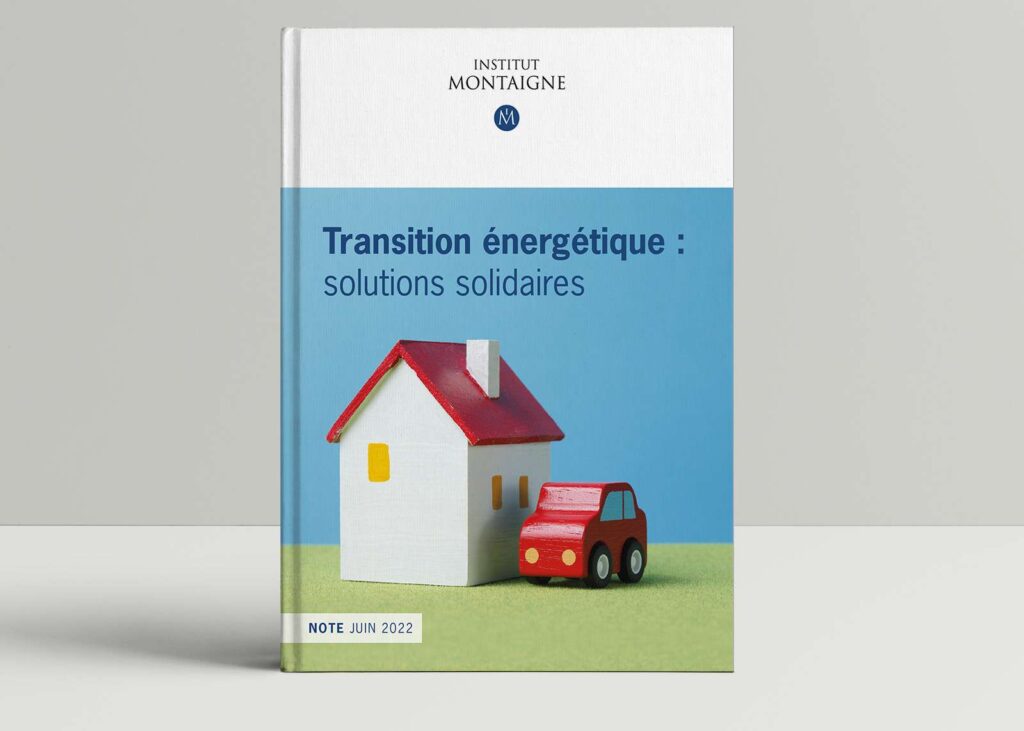
The conclusions of their work are published in a report "Energy transition: solutions based on solidarity which develops 11 proposals for achieving national GHG emission reduction targets in a way that is fair to all.
11 CONCRETE, MUTUALLY SUPPORTIVE PROPOSALS FOR A SUCCESSFUL ENERGY TRANSITION
To be successful on a national scale, the energy transition will need to be accompanied by specific support for the most vulnerable citizens. This applies in particular to housing, transport and food.
Improving technical and financial support for thermal renovation projects
Proposal no. 1
Proposal no. 2

Proposal no. 3
Proposal no. 4
Proposal no. 5
Encouraging the development of different forms of sustainable mobility
Proposal no. 6
Proposal no. 7
Proposal no. 8
Facilitating access for low-income households to local, quality produce
Proposal no. 9
Focusing financial support on the most modest households
Proposal no. 10
Proposal no. 11
WORKING GROUP COMPOSITION
Chairmen
- Benjamin Fremaux, Senior Fellow Energy & Climate, Institut Montaigne
- Marin GillotEnvironment and Energy researcher, Institut Montaigne
People interviewed
- Audrey Zermati, Director of Strategy, Effy Group
- Vincent Legrand, general manager, Dorémi
Project team
- Ophélie Bretaudeau, participatory projects manager, Missions publiques
- Gabriel Chuepo, assistant project manager, Public Missions
- Sophie Conrad, Head of Public Policy, Institut Montaigne
- Théa Disdier-Haumesser, Project Manager, Public Missions
- Alexandre Goddard, research assistant, Institut Montaigne
- Lilou Laleuf, research assistant, Institut Montaigne
Working group
- Fabrice Bonnifet, Director, Sustainable Development & Quality, Safety, Environment, Bouygues Group
- Sandrine de Boras, Head of Innovation, Transdev
- Fabienne Boutière, Design and research engineer, on the themes of energy-efficient home renovation and fuel poverty, EDF R&D - Technologies and Research for Energy Efficiency Department (TREE) - EDF Lab Les Renardières
- Anne Duthilleul, Vice President, Advocacy, Secours catholique
- Benjamin Fremaux, Senior Fellow Energy and Climate, Institut Montaigne, and Chairman and CEO, IDEX
- Thibault Guibert, partner, Eurogroup consulting
- Marie-Emmanuelle Huillo, Director of Institutional Relations, Transdev
- Patrick Jolivet, Director of Socio-Economic Studies, Foresight and Research Executive Division, ADEME
- Catherine Lescure, Director of Communications and CSR, Enedis
- Cécile Maisonneuve, Senior Fellow Cities, territories and sustainable development, Institut Montaigne
- Jean-Yves Mano, President, Consumption, Housing and Lifestyle
- Solène Metayer, Research Fellow, Institute for Climate Economics
- Nicolas Perrin, Director, CSR Division, Enedis
- Patrice Ravel, Managing Director of SIER and Chairman of the Technical Commission of the French Federation of Real Estate Developers SIER Constructeur
- Andréas Rüdinger, Associate Researcher, Institute for Sustainable Development and International Relations (IDDRI)
- Valérie Simon-Prudhomme, In charge of Duty of Vigilance - Sustainable Development, EDF
- Charlotte Vailles, Project Manager, Institute for Climate Economics
Reporter
- Paul Fleurance, assistant to the head of the MULTIFIN4 office - International financial system and preparation of summits - Treasury Directorate General