


For fifteen years, France has been commenting on its industrial decline with almost surgical precision, while in practice accepting a slow erosion of its ability to control its value chains. We know how to diagnose, compare, and alert. But we have not yet managed to act at the level of the ongoing historic shock. The world, meanwhile, has not waited.
The industrial question is no longer an experts' debate. It has become a political reality. It involves a country's capacity to make its own decisions in a world structured by overt power dynamics. While France refines its analyses, competing blocs have made industry the core of their assertion strategy. The United States has broken with thirty years of orthodoxy by deploying massive industrial plans. China is implementing a formidable and coherent strategy, combining upgrading and global normative influence. ASEAN is accelerating towards a decarbonized industry, which has become a lever of competitiveness.
These strategies are neither circumstantial nor ideological: they are precise, targeted, and deliberate.
France doesn't lack vision; it lacks speed and focus.
In a world of acknowledged dependencies, sovereignty no longer consists of producing everything alone, but rather in quickly choosing one's battles and lucidly renouncing those we cannot win. At this stage, not choosing is no longer prudence: it is accepting downgrading.
The time has come to lay the foundations for an offensive industrial model, making clear bets where France can aim for leadership and influence the definition of standards: advanced materials, breakthrough nuclear, biotechnology, defense, space, or complex industrial equipment. Each missed industrial cycle permanently reduces our ability to make decisions.
France has the foundations of a major industrial power: centers of excellence, global champions, and recognized expertise..
It also benefits from underestimated structural advantages: a geography at the center of Europe and multimodal access, making France a natural industrial and logistics hub. When factoring in industrial services, the extended industry represents over 20 % of GDP, the foundation of a contemporary integrated industry. Not converting these advantages into productive power is no longer a delay, it is a renunciation.
Our success now depends on clear choices and our collective ability to execute them. Securing our value chains, mobilizing long-term financing, and making Europe a power multiplier through a "Buy European Act" are essential conditions. However, the state can no longer do everything: the industrial trajectory also depends on businesses' ability to invest, form coalitions, and execute without delay. Finally, it requires massive investment in skills and a collective narrative capable of sustainably reconciling the nation and its youth with industry, by making industrial jobs truly jobs of the future.
This moment marks a turning point: that of a targeted industrial pact, where the state and companies together set the direction and assume both investment and execution.
Industry is no longer a sector; it is a national project. Industry is the condition for lasting French power in the global economy. It is a promise, provided we act quickly. Now.
This editorial was published in the newspaper «La Tribune» on March 18, 2026.
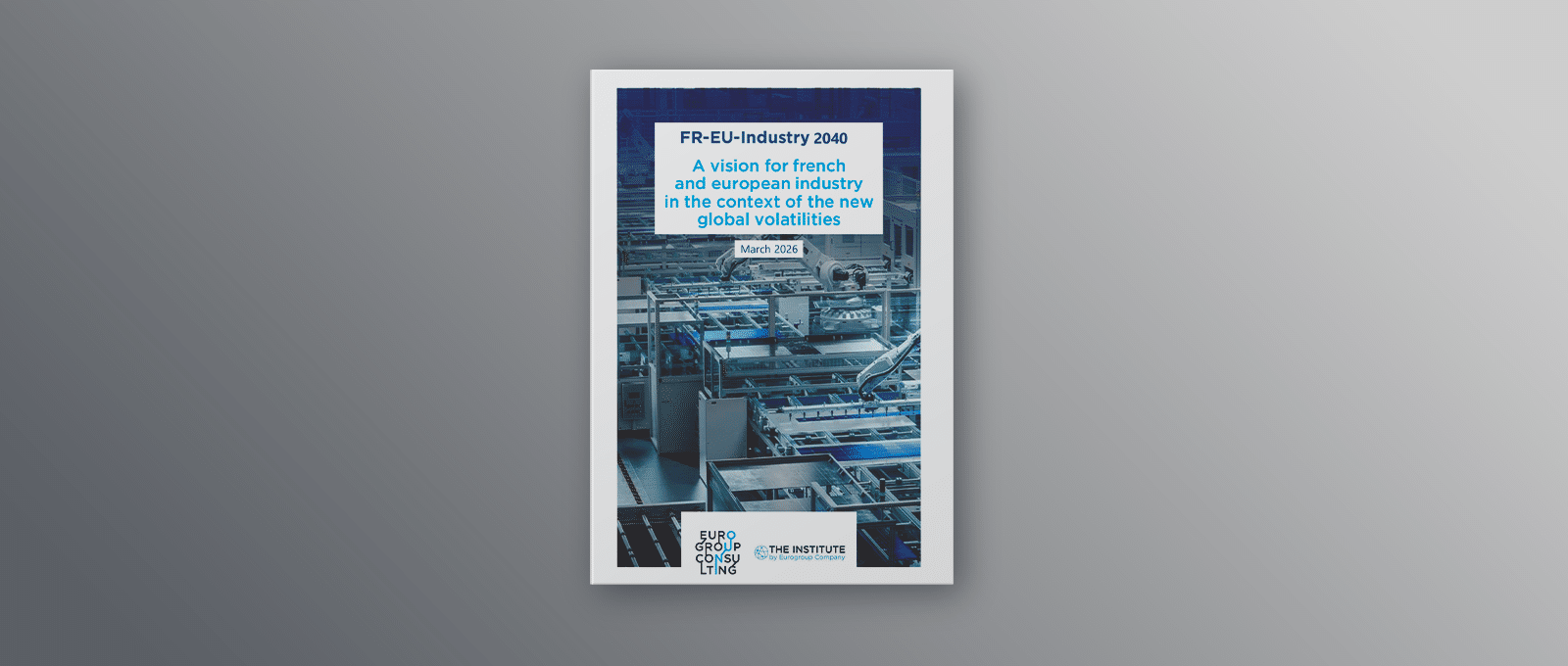
To access the full study: Industry 2040, a vision for French and European Industry.