


It's an open secret that the continuation of current business and consumption models, without change, re-interrogation or consideration of the living, is unsustainable and will lead us into a world where human foresight no longer makes sense, because we won't be around.
Our conviction and starting point is that the business models we have inherited are built on a premise: in an infinite world, nature is made up of resources that we can dispose of without hindrance "as master and possessor", to produce goods and services that are useful or pleasurable to mankind.
- From this perspective, non-human life, the life that surrounds us and its capacity to regenerate, is largely erased from corporate life. The urban form and economic decision-making centers (La Défense, the City...) are just two examples of how little space is given to the life around us.
- However, companies are not "islands": they are part of an environment on which they depend and with which they interact. Ecosystem services are estimated to contribute 50% of global GDP. And if we sometimes don't perceive this directly in service companies, let's go back to our suppliers and partners at 1 or 2 levels to convince ourselves that the place of non-human living beings is fundamental to the sustainable functioning of our societies.
Striking the right balance between short and long term
At a time when the sixth mass extinction has already begun, we're convinced that companies and organizations have the power to change things: destinies are not set in stone, and can point in very different directions. But what can we do? In today's business world, the ability to anticipate, conceptualize and adapt to the future is crucial. The company evolves between a plannable present and an uncertain future. With a vision as its course, it seeks to navigate between these two worlds. How can we use reliable reference points when planning for the near future differs radically from planning for the distant future?
Should the short term be limited to the day-to-day activities of productive divisions? Is the long term relevant, or do impending disruptions require a constant reassessment of urgent priorities?
Strategic narratives as compasses for organizations
At a time when the purely financial framework is reaching its limits, the backbone of a company is no longer its organization, its offering or the experience of its customers. It's what brings these different facets together and produces meaning. This new frame of reference calls for joint management of identity and project.
We believe that there is a sure way for a company to cross the sea that separates it from a recent past from which it draws its knowledge, and from a more distant future which it can only approach today by relying on myths.
There's an uncharted territory out there, waiting to be explored. It will provide the company with answers to today's many unknowns. By building a future connected to its present, the company will chart a safer course, able to navigate without getting lost or sinking. It will consolidate its course, and be in a much better position to conduct its operations more serenely, and make the trade-offs that will enable it to stay on course, whatever the obstacles and contrary currents. And where to start?
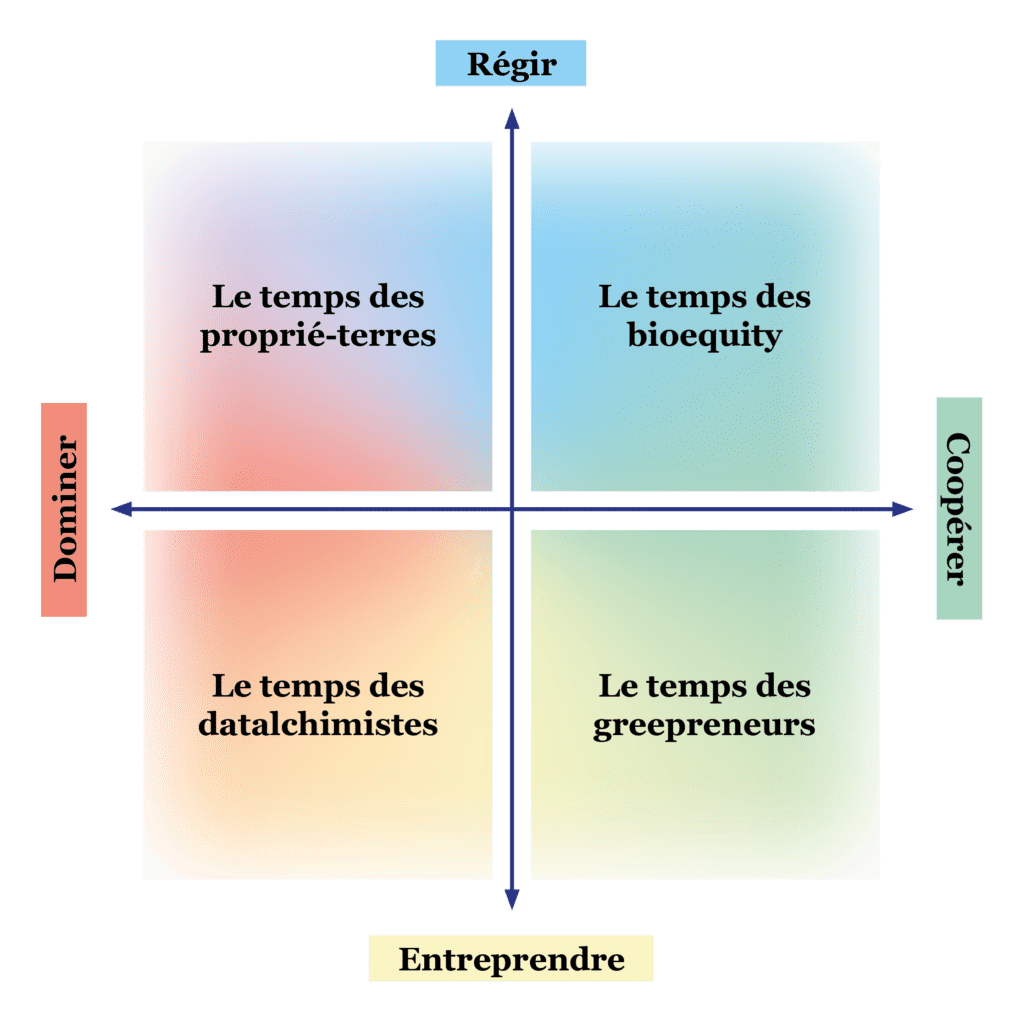
First, we need to explore the emergence of new strategic narratives that will guide future decisions. Eurogroup Consulting & Afterstud.io have developed 4 major strategic narratives. They draw on the work of thinkers such as :
- Christophe Sempels and Bertrand Thuillier
- The research of Johan Rockström
- Planetary limits
- Visit donut theory from Kate Raworth.
An essential framework for understanding the ecological pressures on our planet and the political, economic and social demands at the forefront of our evolution and, perhaps, our survival.
Stories and figures
To create our future stories, we've developed an approach that blends the tools and rigor of foresight with those of design fiction, bringing creativity and originality. With these tools and methods, we don't look for worst-case (dystopian) or best-case (utopian) scenarios, which, in our view, don't allow us to position ourselves strategically. We design scenarios, each with its share of light and shadow, to model the constraints to which companies must adapt today and tomorrow.
By way of illustration, here are a few lines from one of the narratives: what if living beings were tomorrow's majority shareholders in new big corp?
In this scenario, the decline in biodiversity has led government bodies to take radical action.
Organizations' relationship to life in this narrative
The company collaborates with the living, the human and the living are roommates. Companies are all state-owned. The well-being of living beings is the company's main performance indicator. It is represented on the board of decision-makers by independent spokespeople.
To conclude, let's explore today why living things have a future. Join us in this approach to defining business models and integrating life into the heart of our strategies. This article is a foretaste of the in-depth work and the production of our 4 great narratives. Contact us to find out more about these initiatives and be part of this movement towards positive change.
The authors of the project : Barbara Carrière & Romain Varène (Partners at Eurogroup Consulting) and Nicolas Petitjean & Pierre Joaquim (CEO and partner at Afterstud.io).
About our partner Afterstud.io
Afterstud.io, founded by Pierre Joaquim, Nicolas Petitjean and Sonia Aracil, is an applied strategic anticipation studio working alongside partners such as Eurogroup Consulting and its customers. Its mission is to help organizations develop their adaptability in a constantly changing world, and strengthen their robustness in the face of uncertainty.
The studio operates at the intersection of strategic design business designand foresightsand organizational design, focusing on three main areas of expertise:
- Research into future uses by producing strategic, forward-looking content that enables organizations to better anticipate future transformations.
- Strategic support Our aim is to support companies in innovating their products, services and business models, while helping them to adapt to changes in their environment.
- A digital product The new approach: bringing long-term strategic vision closer to concrete, day-to-day action.
Our support for transitions
The world is moving to meet the social and environmental challenges it faces. These challenges are profoundly changing the way we think about business, innovation and management, and the way we prepare for the future. Our approaches, our methods, our postures must be up to the task of this paradigm shift.
Eurogroup Consulting has been committed to these issues for many years, both in its strategic positioning and in its consulting practice. In line with this commitment, we support environmental, social and governance (ESG) transitions and changing business models, for responsible, sustainable organizational performance.