

After a year punctuated by heightened geopolitical tensions, the return of inflation and their multiple consequences on the economy, the leaders of French companies, both large corporations and SMEs, are approaching 2024 with a general feeling of uncertainty.
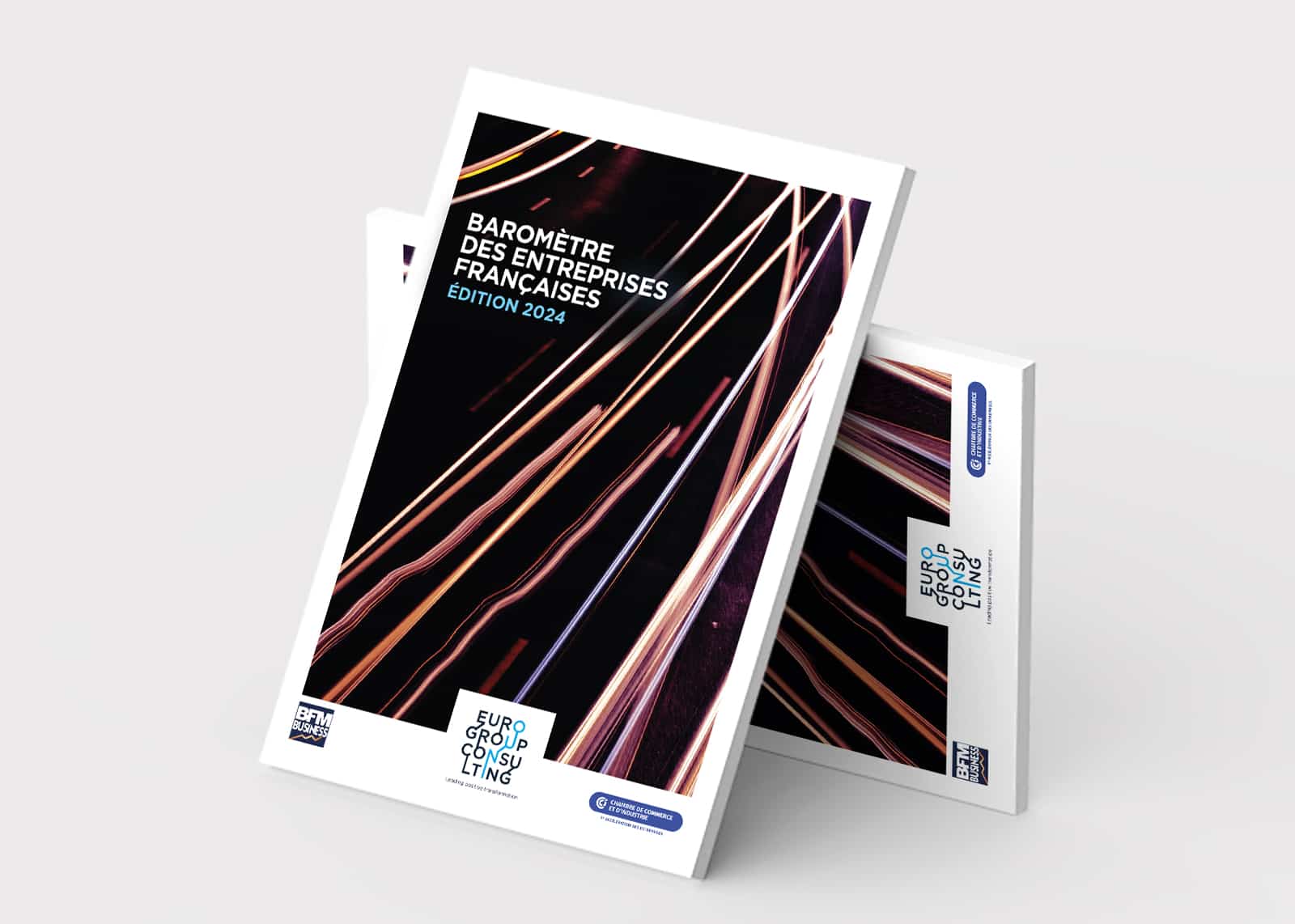
The Baromètre des Entreprises Françaises 2024 is produced in partnership with the Chambers of Commerce and Industry network and BFM Business.
2024: UNCERTAINTY
The year ahead looks set to be a year of change. Whether the business environment worsens or improves, managers are preparing for it with lucidity. Their main challenges remain economic and financial, including maintaining profitability (45 %).
Despite a drastic fall (-20 %) since 2022 in the average indicators, which have stabilized (-3 % vs 2023) at a low level, Managers are relatively confident in the resilience of their companies, which have withstood several crises and will be able to navigate through the next ones: the level of confidence in their profitability forecasts increased by 6.7 %. Whether it's a large group, a small or medium-sized enterprise, the trends observed are relatively similar, whatever the category of company.
oscillate between confidence and uncertainty
average indicators for ETIs and large companies
+6.7%: profitability forecasts
compared with 2023
"Our managers are pragmatic and ready to move forward to preserve the profitability of their companies. This state of mind is reflected in a downturn in investment intentions in France and abroad, but also in a renewed vigilance regarding the management of HR challenges.
Among the dynamics at work in this complex period, it's worth noting the arrival of the ecological transition on the podium of leaders' priorities for 2024, but also the disparities observed on the subject of AI and a persistent underestimation of geopolitical and cyber risks."
GILLES BONNENFANT
Chairman, Eurogroup Consulting
DETAILED RESULTS
A trend towards the status quo
The year 2024 will be marked by a gradual phasing out of economic support measures, the extension the impact of the energy crisis and geopolitical uncertainty. The overall average for the major indicators is down to 4.6, compared with 5.2 last year and 6.4 in 2022.
Three of the four indicators studied deteriorated in France:
Activity
-0.2 points
Workforce
-0.8 points
Investments
-0.9 points
MAIN PERCEIVED RISKS
In a context marked by a return to fiscal austerity and rising central bank interest rates, the greatest risks perceived by managers remain economic and financial..
Despite the worsening international political tensions, geopolitical and security risks come second to last, followed by cyber riskscited by only 5 % of company managers.
70% of managers give top priority to economic and financial risks
compared with 2023
KEY PRIORITY CHALLENGES
Profitability, cited by 45 % of managers, remains by far the most important factor. Human resources challenges are on the rise in 2024, and rank second among the concerns of business leaders.
Employee commitmentwhich was seen as a force to be reckoned with in the aftermath of the Covid crisis, is now now at the forefront of HR concerns executives.
The challenges to the ecological and energy transition are making inroads and, for the first time, are among the top three priorities to be addressed. The ecological transition is now an unavoidable regulatory imperative, and a necessary response to today's energy challenges.
Faced with rising energy costs, 68% of managers are asking more specifically about their energy efficiency and sustainable purchasing strategies.

COMPANIES AND THE DEVELOPMENT OF IA
Artificial Intelligence is perceived very differently by decision-makers. While 58% of large companies and ETIs see it essentially as a lever for competitiveness, 61% of SME bosses say they don't feel concerned.
Meanwhile, only 16% of managers consider that AI is perceived by their employees as a threat to their jobs.
FIND OUT MORE ABOUT THE BAROMETER METHODOLOGY
Each year, the Baromètre des entreprises françaises assesses the dynamism and challenges facing the French economy through the eyes of its managers.
Conducted in partnership with BFM Business and the network of Chambers of Commerce and Industry, this study combines a forward-looking vision, an analysis of the dynamics at work in companies, and operational priorities.
This survey is based on the responses of over 500 managers from a wide variety of SMEs, ETIs and large companies, representative of the French economy (according to the French economic fabric presented by INSEE).